Why Your Creative Opposite Might Be the Best Partner You'll Ever Have
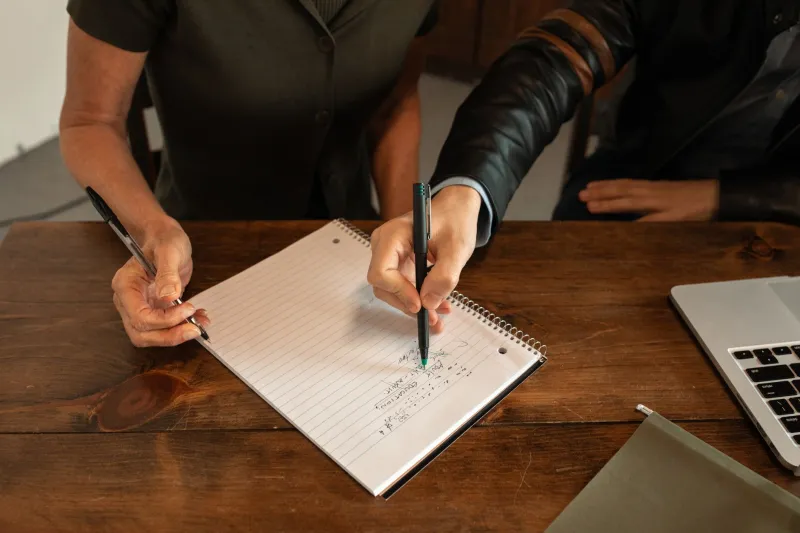
Most of us gravitate toward collaborators who get us. People who laugh at the same references, finish our sentences, and share our instincts about what makes something work. It feels efficient. Safe. Productive, even.
But here's the thing — safe rarely makes something worth remembering.
Some of the most celebrated work in film, music, and television didn't come from creative soulmates. It came from two people who probably drove each other absolutely crazy at least half the time. And that tension, that friction between opposing ways of thinking, turned out to be the whole point.
The Planner and the Improviser
Think about what happens when a meticulous, outline-everything type sits down with someone who builds entirely on instinct. On paper, it sounds like a disaster. One person wants a roadmap. The other wants to start driving and figure it out.
But watch what actually happens in practice. The planner forces the improviser to articulate why an instinct is worth following — and that articulation almost always makes the idea stronger. Meanwhile, the improviser keeps the planner from over-engineering something into lifelessness. Structure meets spontaneity, and the result is work that has both bones and a heartbeat.
This dynamic played out in a pretty famous way between the Coen Brothers and their longtime cinematographer Roger Deakins. Joel and Ethan Coen are meticulous to an almost obsessive degree — their scripts arrive nearly fully formed, their shot lists are detailed, their tonal intentions are locked in before a camera rolls. Deakins brings a more intuitive sensibility to the frame, often pushing for a visual simplicity that contradicts the Coens' instinct to control every inch of the image. The result — films like No Country for Old Men and Fargo — carries both qualities simultaneously. Precision and naturalism. Control and breath. Neither artist alone would have landed in that exact place.
When Words Meet Images
The writer-visual artist pairing is one of the oldest creative collaborations in storytelling, and it's also one of the most reliably explosive. These two people don't just have different skills — they have fundamentally different ways of processing reality.
A writer tends to think in sequence. Cause, effect, meaning, consequence. A visual artist tends to think in simultaneity — everything in a frame exists at once, communicating without hierarchy. When these two modes of thinking collide, something strange and useful happens. The writer starts asking what does this image mean in ways the visual artist never had to answer before. The visual artist starts pushing back against the writer's instinct to over-explain, to resolve, to wrap things up neatly.
Look at the early collaboration between David Lynch and composer Angelo Badalamenti on Twin Peaks. Lynch is fundamentally a visual and emotional thinker — he's famously resistant to explaining his work in linear terms. Badalamenti, trained in classical composition, operates with a much more structured musical logic. Lynch would describe a feeling or a color or a texture, and Badalamenti would translate that into something with actual harmonic structure. The music that came out of that process is neither purely Lynch nor purely Badalamenti. It's something that required both of them to exist at all.
The Discomfort Is the Feature, Not the Bug
Here's what nobody tells you about working with your opposite: it's going to feel inefficient. There will be conversations that go in circles. There will be moments where you're genuinely convinced the other person doesn't understand what you're trying to do. You might be right. That's fine.
The point isn't seamless agreement. The point is that friction generates heat, and heat — when you don't run from it — can reshape things.
In the music world, the Lennon-McCartney partnership is the case study everyone reaches for, and for good reason. Lennon's tendency toward raw emotional directness and McCartney's instinct for melodic polish and structural tidiness produced a creative tension that neither could fully resolve on their own. When they were genuinely collaborating, the roughness and the sweetness existed in the same song. When they started working separately, both of their solo catalogs — while containing brilliant moments — never quite hit the same register that their friction produced together.
Finding Your Opposite on Purpose
So what does this mean practically? It means that the next time you're putting together a project, it might be worth resisting the instinct to build a room full of people who already agree with each other.
Seek out the person whose process makes you a little uncomfortable. The one who asks questions you find tedious. The one who keeps wanting to slow down when you want to accelerate, or who keeps pushing forward when you want to refine.
That person is not the obstacle. That person is the collaborator.
The goal isn't to abandon your own creative perspective — it's to stress-test it. When your instincts survive contact with a genuinely different mind, they come out stronger. When they don't survive, you've just been saved from something that wouldn't have worked anyway.
The Work That Neither Could Make Alone
There's a particular kind of creative work that you can identify almost by feel — work that seems to contain more than one consciousness, that holds contradictions without resolving them, that surprises you even when you can see its craft clearly. That quality almost never comes from a single voice working in isolation.
It comes from the planner who learned to let go a little. The improviser who learned to hold a thought long enough to examine it. The writer who stopped over-explaining. The visual artist who started asking what things mean.
The collaboration paradox is this: the person most unlike you is often the one who helps you make the truest version of what you were trying to make all along. You just needed someone to push back hard enough to find it.